










Hak Cipta © 2026 ROTER Fresh Air Technology Wuxi Co., Ltd. Hak Cipta Terpelihara. Website Design by Wangke
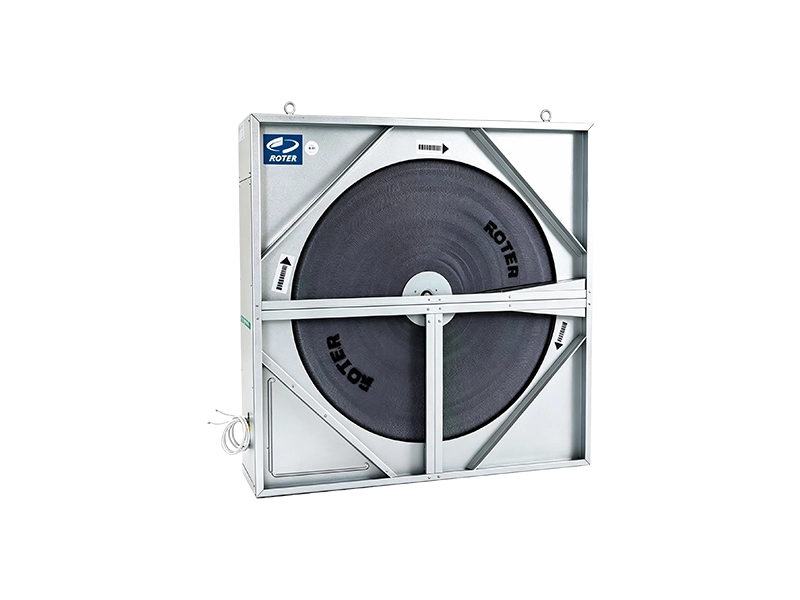
Penukar Haba Roda
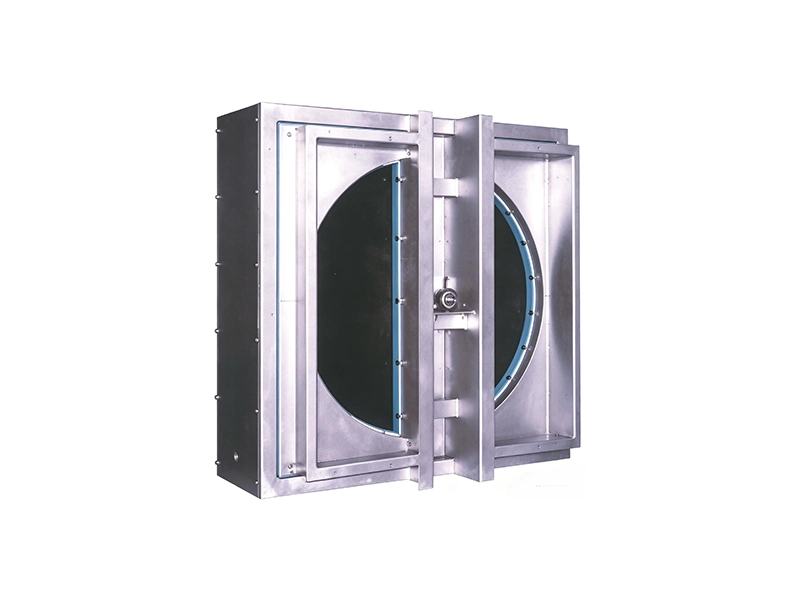
Unit Roda Pemulihan Haba
A rotary heat exchanger recovers heat through a rotating matrix rather than through a fixed surface. The rotor turns continuously and acts as a heat and cold storage core: hot exhaust air gives up its heat to the matrix on one side, and the matrix gives that heat back to the incoming fresh air as it rotates through. Because the two air streams exchange energy through the same rotating core, the recovery rate is high even in a compact unit, and the same core can carry both sensible and latent load when it is fitted with molecular-sieve desiccant.
| Product | What it is | Link |
|---|---|---|
| Wheel heat exchanger (ROTER-HRW) | The rotary heat recovery core itself. ROTER's production line for heat recovery rotor cores, its molecular-sieve desiccant and its special aluminium foil process are directly sourced from the United States, and cores are manufactured in various specifications. | Details |
| Heat recovery wheel unit | The rotating core in unit form. The rotor rotates continuously at 10 rpm as a heat-storage or cold-storage core, with fresh air through one semi-circle and exhaust air counter-currently through the other. | Details |
Fresh air passes through one semi-circle of the rotary heat exchanger while exhaust air simultaneously flows counter-currently through the other semi-circle. In this way the two streams pass through the rotor alternately and in opposite directions, and the exhaust air releases its heat into the heat-storage or cold-storage core. Up to 75% of the thermal energy in the exhaust air can be recovered.
ROTER rotary heat exchangers are used where exhaust-air energy recovery improves the efficiency of an air conditioning system and increases the fresh-air supply volume without additional energy consumption. In practice this covers large ventilation volumes in commercial buildings, industrial exhaust heat recovery, hospital and laboratory ventilation where humidity must also be controlled, and hospital-grade fresh air systems that pair with the Fresh Air System and the Desiccant Dehumidifier.

Perusahaan berasaskan teknologi khusus untuk penyelidikan kualiti udara dan pembuatan profesional peralatan pengudaraan yang cekap dan menjimatkan tenaga